
What Is a Palworld Breeding Calculator?
A Palworld Breeding Calculator is an essential online tool that allows players to instantly find every possible breeding combination in Palworld without trial and error. Instead of wasting hours guessing which two Pals to pair, a breeding calculator gives you the exact parent combinations needed to produce any specific Pal offspring.
Whether you want to breed the powerful Anubis for base work, the legendary Jormuntide Ignis for combat, or a rare Fusion Pal variant, the breeding calculator removes all the guesswork. It works by simulating the game’s internal Breeding Power Value (BPV) formula, matching parent averages to the closest child species in the game’s database.
The best Palworld Breeding Calculator available in 2025 offer:
- Parent-to-Child lookup — enter two parent Pals and see their offspring
- Child-to-Parent lookup — enter the Pal you want and see all parent combinations that produce it
- Chain Breeding Calculator — shows the shortest multi-step path from any Pal to any other Pal
- Passive Skill Inheritance Planner — helps you chain breed specific passive skills onto offspring
- IV/Stat Checker integration — lets you evaluate the strength of bred Pals
Palworld Breeding Calculator
Find offspring, parent combos & breeding chains for all Pals
Find the shortest path to breed any Pal from any starting Pal.
Build Farm
Unlock Breeding Farm at Tech Level 19 using Wood, Stone & Fiber
Bake Cake
Craft Cake using Flour, Eggs, Milk, Honey & Berries at Cooking Pot
Pair Pals
Place one Male + one Female Pal of any species into the farm
Hatch Egg
Use Egg Incubator (Level 7) to hatch your offspring faster
Formula
Child rank = floor((Parent1 rank + Parent2 rank + 1) / 2)
Unique Combos
Some pairs produce special Fusion Pals, overriding the normal formula
How Breeding Works in Palworld — The Core Mechanics
Understanding the breeding system before using a calculator makes you a far more efficient breeder. Palworld’s breeding system is unique in that Pals of completely different species can breed together, and the resulting offspring is determined mathematically — not randomly.
Here are the four key principles:
1. Different Species Can Breed
Pals do not need to be the same species to breed. A Fire-type and a Dragon-type Pal can breed and produce an Ice-type offspring. This cross-species breeding is the backbone of the entire breeding system and makes calculators an absolute necessity for planning.
2. Every Pal Has a Hidden Breeding Power Value
Each of the 100+ Pals in Palworld has a hardcoded Breeding Power Value (BPV) assigned by the developers. This number ranges from 10 to 1500. The lower the number, the rarer and more powerful the Pal. For example:
- Anubis: BPV 570
- Jormuntide: BPV 580 (very rare)
- Mau: BPV 1480 (very common)
- Cattiva: BPV 1460 (very common)
3. The Offspring Is Mathematically Determined
The game takes both parents’ BPVs, averages them, then selects the Pal species whose BPV is closest to that average. This is deterministic — not random. The same two parents will always produce the same offspring species (though passive skills and IVs do vary).
4. You Can Never Breed a Pal Stronger Than Your Best Parent
This is a critical rule every breeder must understand. Your bred offspring can never have a BPV lower (stronger/rarer) than your most powerful parent. The breeding system locks you into working within the range of your existing Pals. However, through chain breeding, you can gradually work your way toward rarer Pals.
5. Passive Skills Can Be Inherited
Unlike species, passive skills are not fully deterministic. A child can inherit between 1 and 4 passive skills from the combined pool of both parents’ skills. This randomness is what makes chain breeding for passive skills a key end-game activity.
The Breeding Power Formula Explained
The exact formula used by Palworld Breeding Calculator to determine offspring is:
Child BPV = floor((Parent1 BPV + Parent2 BPV + 1) / 2)
In plain English: add both parents’ Breeding Power Values together, add 1, divide by 2, and round down to the nearest whole number. The game then selects the eligible Pal species with the BPV closest to this result. Palworld Breeding Calculator.
Example:
- Anubis (BPV: 570) + Cattiva (BPV: 1460)
- (570 + 1460 + 1) / 2 = 1015.5 → floor = 1015
- The Pal closest to 1015 is Robinquill (BPV: ~1000–1020)
- Result: Robinquill
Tiebreaker Rule: When two Pal species are equidistant from the calculated BPV, the game selects whichever appears first in the internal game file index.
Important exception: Some Pals use special, hardcoded breeding combinations that override this formula entirely. These are called Unique Breeding Combos and are covered in a dedicated section below. Palworld Breeding Calculator
This formula is why a breeding calculator is so powerful — it has the entire BPV table pre-loaded and instantly performs this calculation across all possible parent pairs to show you exactly which Pals produce which offspring.

How to Set Up Your Breeding Farm (Step-by-Step)
Before you can use any Palworld Breeding Calculator results in-game, you need to actually build and operate a Breeding Farm. Here is exactly how to do it:
Step 1: Unlock the Breeding Farm at Technology Level 19
The Breeding Farm is unlocked at Technology Tree Level 19. You need to spend Technology Points to unlock it. Once unlocked, you can build it at your base.
Required Building Materials:
- 100 Wood
- 20 Stone
- 50 Fiber
Step 2: Build the Breeding Farm at Your Base
Open your build menu and place the Breeding Farm at your base. Make sure it has enough open space around it for Pals to roam.
Step 3: Craft Cake Using the Cooking Pot
Cake is the essential resource required for Pals to breed. Without Cake placed in the box outside the Breeding Farm, breeding will not proceed. Build a Cooking Pot and use a Pal with the Kindling work suitability to bake the Cake.
Cake Recipe:
- Flour (from wheat at a Mill)
- Eggs (from Chickpeas or farm Pals like Chikipi)
- Milk (from Mozzarina — a Pal you need to keep in your base)
- Honey (from Beegarde — another farm Pal)
- Red Berries
💡 Pro Tip: Set up dedicated farm Pals — specifically Beegarde (for honey) and Mozzarina (for milk) — to automate Cake production. Running out of Cake mid-breeding is one of the most common mistakes.
Step 4: Assign One Male and One Female Pal
Pick up a Male Pal and a Female Pal and throw them into the Breeding Farm pen. The Pals must be opposite genders. Most Pals have a 1:1 male-to-female ratio, but some rare Pals have skewed gender ratios, making it harder to get the gender you need for specific combos.
Step 5: Place Cake in the Breeding Box
Open the storage box outside the Breeding Farm and deposit your Cake. The breeding progress bar will begin filling once both a male and female Pal are inside and Cake is available.
Step 6: Wait for the Egg to Be Laid
When breeding begins, you will see the message: “Love is blossoming between the two Pals.” Wait for the progress bar to fill completely, and an egg will be laid.
Breeding Speed Tips:
- Having the Pal Braloha present at your base improves breeding speed
- If both Pals have the passive skill Nocturnal, they will not stop breeding at nighttime — significantly speeding things up
- Pals with the Philanthropist passive skill also improve breeding speed
Step 7: Incubate the Egg
Use the Egg Incubator (unlocked at Technology Level 7, requires 30 Wood, 5 Cloth, 2 Ancient Civilization Parts) to hatch the egg. Keep the incubator at the correct temperature for the egg type to speed up hatching. Palworld Breeding Calculator
How to Use a Palworld Breeding Calculator
Now that your Breeding Farm is operational, here is how to get the most out of a Palworld breeding calculator tool:
Method 1: Find Parents for a Specific Target Pal (Child → Parents)
This is the most common use case. You know which Pal you want to breed and need to find the parent combinations.
- Open a Palworld Breeding Calculator
- Select your Target Pal from the dropdown or search bar
- The calculator will show all possible parent combinations that produce your desired offspring
- Sort results by “Best Combos” to see the easiest parent pairs (Pals that are common and easy to obtain)
- Go breed those parents in your Breeding Farm
Method 2: Find the Offspring of Two Specific Parents (Parents → Child)
If you have two Pals already and want to know what they will produce:
- Enter Parent 1 and Parent 2 in the Palworld Breeding Calculator
- The result field instantly shows the offspring species
- Use this to plan which Pals in your current collection can produce useful offspring
Method 3: Chain Breeding Calculator
For advanced players breeding rare Pals step-by-step from common starting Pals:
- Enter your Source Pal (what you currently own)
- Enter your Desired Pal (what you want to eventually create)
- The calculator generates the shortest chain of breeding steps to get there
- Follow each step in order, using each offspring as a parent in the next step
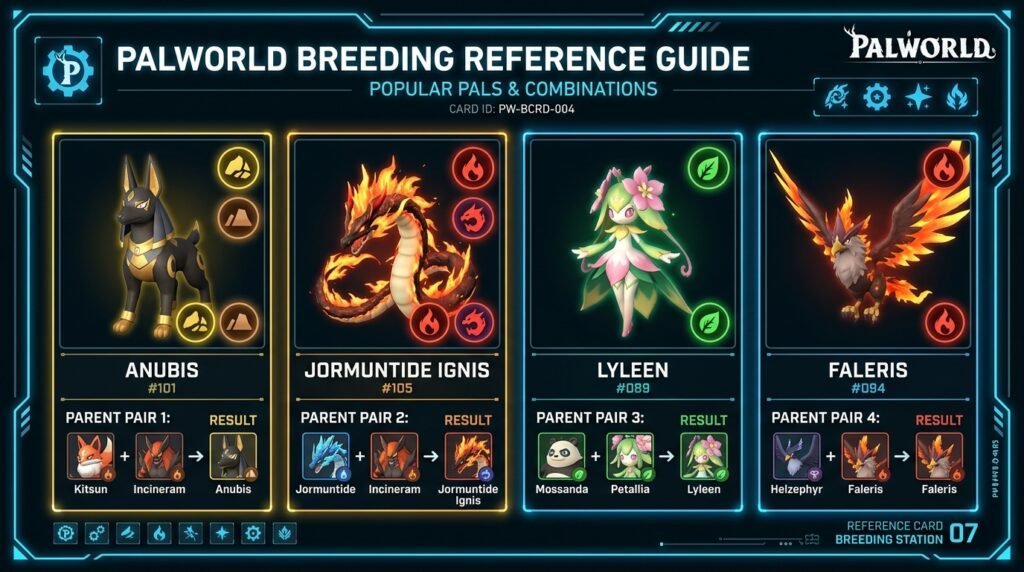
Best Breeding Combos in Palworld (2025)
Below are some of the most sought-after breeding combinations, verified and updated for the 2025 Home Sweet Home update. All combinations have been tested for accuracy.
Best Combat Pals to Breed
| Target Pal | Parent 1 | Parent 2 | Why Breed It |
|---|---|---|---|
| Anubis | Penking | Bushi | Mining Lv.3, Handiwork Lv.4 — elite base worker |
| Jormuntide Ignis | Jormuntide | Relaxaurus Lux | Powerful fire-type combat Pal |
| Shadowbeak | Kitsun | Astegon | One of the best night-fighting combat Pals |
| Necromus | Relaxaurus | Shadowbeak | Elite Dark-type combat Pal |
| Paladius | Necromus | Relaxaurus Lux | Powerful Neutral combat Pal |
| Frostallion Noct | Frostallion | Helzyphyr | Legendary Dark-type flying mount |
| Lyleen Noct | Menasting | Lyleen | Night worker with planting and medicine |
Best Base Worker Pals to Breed
| Target Pal | Parent 1 | Parent 2 | Why Breed It |
|---|---|---|---|
| Anubis | Multiple combos | See calculator | Top mining + handiwork Pal |
| Wumpo Botan | Wumpo | Mammorest Cryst | Transporting Lv.4 — moves huge item stacks |
| Lyleen | Petallia | Mossanda | Planting + Medicine — essential farm Pal |
| Beegarde | Elizabee | Gorirat | Only Pal producing Honey for Cake |
| Mozzarina | Melpaca | Mammorest | Only Pal producing Milk for Cake |
| Blazehowl | Vanwyrm | Arsox | Kindling Lv.3 + Lumbering Lv.2 — dual worker |
| Faleris Aqua | Faleris | Surfent Terra | Watering Lv.4, new from Feybreak Update |
| Petallia | Various | Various | All-rounder farm Pal, excellent passive skill base |
Best Riding/Mount Pals to Breed
| Target Pal | Best Traits | Notes |
|---|---|---|
| Fenglope | Double jump ability | High-speed land mount |
| Kitsun | Heat/cold immunity | Ride through any biome |
| Galeclaw | Faster than Mega Glider | Aerial soaring Pal |
Passive Skill Inheritance: How It Works
Passive skills (also called Traits) are one of the most strategically important aspects of Palworld Breeding Calculator. Unlike the species of the offspring (which is deterministic), passive skill inheritance involves a degree of randomness, which is why chain breeding is required to stack the best skills.
The Passive Skill Inheritance Rules
- Combined Pool: The game takes all passive skills from both parents and combines them into one pool (removing duplicates).
- Number of Inherited Skills: The child inherits between 1 and 4 passive skills from this pool, selected at random. The probabilities are weighted — inheriting 4 skills is possible but the least likely outcome.
- Random Generation: In addition to inherited skills, the child may also gain a randomly generated passive skill that neither parent has. This can be good (getting a rare skill) or bad (introducing a negative skill).
- No Skill is Permanently Locked: Even extremely rare skills like Legend can be passed from parent to offspring through chain breeding.
Top Tier Passive Skills to Breed For
Combat Skills:
- Legend — Increases Attack, Defense, and Speed simultaneously. The most valuable combat skill in the game.
- Musclehead — Greatly increases Attack Power but reduces Work Speed. Best for pure fighters.
- Ferocious — Increases Attack Power. Slightly less powerful than Musclehead but no work speed penalty.
- Swift — Increases Movement Speed significantly.
- Brave — Increases Attack Power with no downsides.
Work Skills:
- Artisan — Greatly increases Work Speed. The single most valuable work skill.
- Work Slave — Increases Work Speed (slightly less than Artisan but stackable).
- Serious — Increases all stats moderately.
- Conceited — Increases Work Speed but decreases Defense.
The Gold Standard Work Combination: Breed Anubis with Artisan + Work Slave + Serious + Ferocious for the ultimate base work Pal.
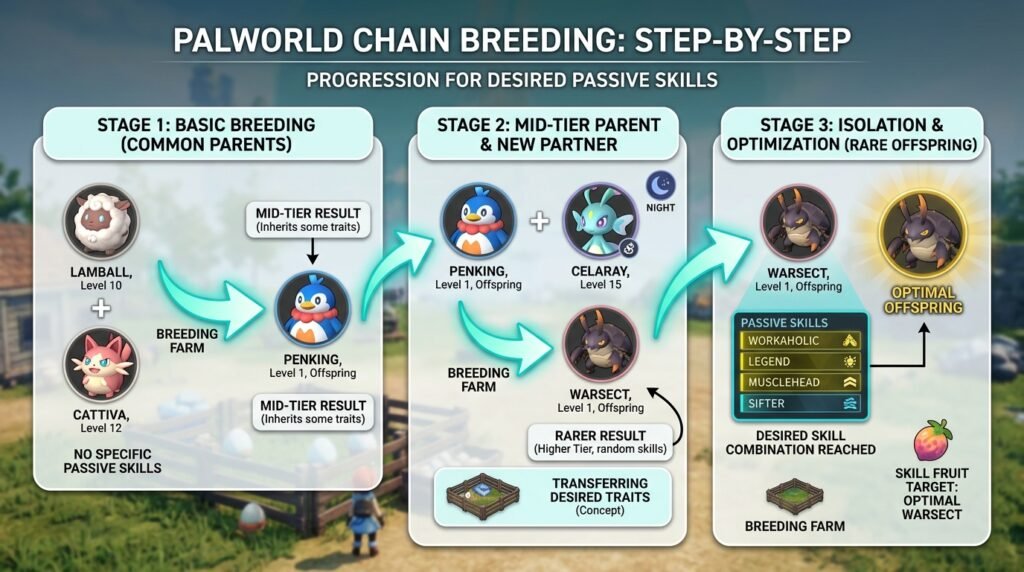
Chain Breeding in Palworld: The Advanced Strategy For Palworld Breeding Calculator
Chain breeding is the process of using multiple sequential breeding steps to produce a rare or powerful Pal that cannot be directly obtained from the Pals you currently own. It is also the primary method for stacking multiple elite passive skills onto a single Pal.
Why Chain Breeding Is Necessary
As established earlier, you can never breed a Pal with a lower BPV (more rare) than your most powerful parent. This means if you do not already own a powerful rare Pal, you cannot instantly breed one. Chain breeding solves this by letting you gradually approach the target BPV over multiple breeding generations.
Example Chain:
- You want Anubis (BPV: 570) but only own common Pals
- Step 1: Breed Penking (BPV: 430) + Bushi (BPV: 710) → Anubis (BPV: ~570) ✓
- This specific combo works because both parents average out to Anubis’s BPV
For passive skills, chain breeding allows you to accumulate 4 elite skills across parents and pass them to offspring over multiple generations. This is tedious but produces the strongest possible Pals.
How to Use the Chain Palworld Breeding Calculator
- Go to Game8’s Chain Breeding Calculator or a similar tool
- Enter your Source Pal (the Pal you currently own)
- Enter the Target Pal (what you want to eventually breed)
- The calculator returns the shortest breeding path, sorted by fewest steps
- Follow each step sequentially — each offspring becomes the parent for the next step
- The Breeding Combo Length column tells you how many breeding sessions you need
Chain Breeding Tips
- Always start with the shortest breeding chain available — unnecessary extra steps waste time and Cake
- When chain breeding for passive skills, prioritize parents that already carry 2–3 desired skills each
- Use a dedicated passive skill spreadsheet to track which skills each parent in your chain carries
- Breed multiple eggs simultaneously and select the offspring with the best passive skill combination before proceeding to the next chain step
- The Google Spreadsheet breeding tool from Game8 allows you to input all your owned Pals and see what offspring are possible from your current collection
Unique and Special Breeding Combinations
Not all Pals follow the standard BPV formula. Some Pals can only be obtained through specific, hardcoded breeding combinations and will not appear through the standard calculation method. These are the combinations every serious player needs to memorize (or bookmark in a calculator).
Same-Species Breeding Rule
Approximately 12 Pals can only be bred by pairing two parents of the same species. Breeding two parents of the same species always produces an offspring of that same species — this is also the main method for consolidating and stacking passive skills without changing the offspring species.
Variant/Fusion Pal Combinations
Most Variant Pals (element variants of existing Pals) do not use the standard BPV system. They can only be bred from:
- Two parents of their own species, or
- Two specific species that are hardcoded to produce them
Notable Example:
- Katress + Wixen: The result depends on gender. A female Wixen produces Wixen Noct, while a female Katress produces Katress Ignis. This gender-dependent result is unique in the game.
Standard exception note: Kelpsea Ignis and Wumpo Botan DO follow the standard BPV combination method and are not subject to the special-combination-only rule.
Tower Boss Pal Breeding
Tower Boss Pals (the bosses from the game’s Pal Towers) also use special breeding rules. They can only be bred either from:
- Two parents of their own species, or
- Two specific designated parent species
Always check a breeding calculator’s special combinations section for the exact pairings.
Alpha Pal Breeding
A bred Pal has a 5% chance of being an Alpha Pal. Alpha status is completely independent of the parents — it is not inherited. However, if the offspring is an Alpha:
- The egg is always Huge-sized, regardless of normal egg size for that species
- Alpha Pals get significantly more HP than standard Pals of the same species
- Important caveat: Wild-caught Legendary Alpha Pals are generally stronger than bred Legendary Alphas (unless the bred Alpha happens to have ideal passives). This is because wild Legendaries come with inherently boosted stats. Breeding is still worthwhile for perfect passives.

Fusion Pals: How to Breed Variant Pals
Fusion Pals (also called Variant Pals or Subspecies Pals) are alternate elemental versions of existing Pals. They look visually distinct and often have different element types and work suitabilities compared to their base form, making some variants significantly more valuable than the originals.
What Are Fusion Pals?
Breeding certain specific parent combinations produces a Pal variant — a new Pal that is different from both parents. For example, breeding a Jormuntide with a Relaxaurus Lux can produce the fire-variant Jormuntide Ignis, which is a different and arguably more powerful Pal than the base Jormuntide.
Variants are recognizable by their element suffix: Ignis (Fire), Terra (Ground), Cryst (Ice), Noct (Dark), Aqua (Water), Botan (Grass).
Key Fusion Pal Combos Worth Knowing
- Incineram Noct — Dark variant of Incineram; bred from Incineram + Maraith
- Eikthyrdeer Terra — Ground variant; bred from Eikthyrdeer + Hangyu Cryst
- Frostallion Noct — Legendary Dark flying mount; bred from Frostallion + Helzyphyr
- Lyleen Noct — Dark farm Pal; bred from Menasting + Lyleen
- Jormuntide Ignis — Fire water dragon; bred from Jormuntide + Relaxaurus Lux
- Faleris Aqua — Water variant from Feybreak Update; bred from Faleris + Surfent Terra
Always verify current variant combos in a live calculator, as new Pals added in updates (like the Home Sweet Home update in December 2025) may introduce new variant breeding requirements.
Best Pals to Breed for Base Work vs. Combat
One of the most important decisions in Palworld is choosing whether to prioritize base efficiency or combat power when breeding. Here is a breakdown of the top targets for each category.
Top Breeding Targets for Base Workers
Anubis is universally considered the single best base worker to breed. It has Mining Level 3 and Handiwork Level 4, making it indispensable from mid-game onward. Breeding Anubis with the passive skills Artisan and Work Slave creates one of the most efficient base Pals in the game.
Lyleen excels in farming, with planting and medicine production capabilities. Start by breeding Petallia — an all-purpose farm Pal with excellent passive skill inheritance — then use it as a stepping stone to breed Lyleen.
Wumpo Botan holds Transporting Level 4, meaning it moves larger item stacks faster than almost any other Pal. Pair it with Artisan and Serious passives for optimal base logistics.
Petallia covers nearly all farm work except Watering and should be an early breeding priority for any player serious about base automation. Because Petallia is also needed to breed Lyleen, breeding a Petallia with great passive skills first ensures those skills carry forward.
Beegarde and Mozzarina are non-negotiable if you plan to breed Pals at scale. They are the only Pals that produce Honey and Milk respectively — both required ingredients for Cake. Without these two Pals in your farm, Cake production bottlenecks your entire breeding operation.
Top Breeding Targets for Combat
Shadowbeak is one of the strongest combat Pals for end-game play, especially during night encounters. Breed it with Legend, Musclehead, and Ferocious for maximum damage output.
Necromus and Paladius are the dual Legendary ground-type Pals. Breeding them requires specific parent chains but results in two of the most powerful late-game combatants available.
Frostallion Noct is the only Legendary Dark-type flying mount, combining extreme combat ability with high-speed aerial movement. It is one of the rarest and most desirable Pals to breed.
Breeding Tips, Tricks & Common Mistakes
Tips for Efficient Breeding
Automate Cake Production First Before starting any serious breeding project, build a fully automated Cake production line. You need Beegarde for Honey, Mozzarina for Milk, Chikipi for Eggs, and a mill with wheat for Flour. Without automation, running out of Cake constantly disrupts your breeding sessions.
Use the “Sort by Best Combos” Filter Most calculators offer a sort option that ranks parent combinations by ease of obtaining the parents. Always use this to find the most accessible parents first — there is often a simple combo using very common Pals that you may overlook.
Breed Multiple Eggs for Better Passives Since passive skill inheritance is random, breed at least 5–10 eggs when aiming for a specific passive skill combination. Select the best offspring and use it as a parent for the next generation.
Check Gender Ratios Before Planning Some Pals are predominantly one gender. If a rare Pal is 70% male, getting a female version for breeding will take significantly more time. Plan your breeding chain around these gender constraints.
Use Nocturnal Pals for Faster Breeding If both parents in your Breeding Farm have the Nocturnal passive skill, they will continue breeding through the night without stopping, dramatically cutting breeding time for long sessions.
Speed Up with Braloha The Pal Braloha present at your base passively improves breeding speed. Keep one in your base whenever you have active breeding running.
Common Mistakes to Avoid
- Not making Cake in advance: Always have at least 5–10 Cakes stockpiled before starting a breeding project
- Ignoring IVs: After securing good passive skills on an offspring, use an IV Calculator to check if its base stats are worth keeping or if you should breed again
- Breeding without a plan: Always look up the target breeding chain before starting. Improvised breeding wastes huge amounts of time and Cake
- Forgetting about gender availability: Always confirm you can obtain the right gender of a required parent before starting a chain
- Skipping intermediate passive skill checks: When chain breeding for passives, check each offspring’s skills before using it as the next parent — propagating a bad passive skill through multiple generations wastes enormous time

FAQs About Palworld Breeding Calculator
Multiple excellent calculators are available. Game8’s Breeding Calculator is the most feature-rich, offering both standard and chain breeding calculators. Palworld.gg has a clean interface and fast lookup. Palpedia covers unique combos and wild egg mechanics in one place. Most experienced players use 2–3 tools together for comprehensive coverage.
The formula is: floor((Parent1 BPV + Parent2 BPV + 1) / 2) = Child BPV. The resulting BPV is matched to the closest Pal species in the game’s database. Every Pal’s BPV is a fixed number between 10 and 1500, hardcoded by the developers.
Yes. Breeding two Pals of the same species always produces offspring of that same species. This is the primary method for stacking and consolidating passive skills without changing the offspring’s Pal type.
Between 1 and 4 passive skills are inherited from the combined passive pool of both parents. The child may also randomly gain a new skill not present in either parent. Because of this randomness, breeding multiple eggs and selecting the best offspring is standard practice.
Legendary Pals — including Frostallion, Necromus, Paladius, Jetragon, and their variants — are the rarest and most difficult to breed due to their very low BPVs and the specific parent requirements needed to produce them.
Yes, breeding two of the same species always produces the same species. However, passive skills and IVs on the offspring will vary each time.
Yes. Any bred Pal has a 5% chance of being an Alpha regardless of parent status. Alpha Pals always hatch from Huge-sized eggs and receive significantly more HP.
Breeding time varies based on the Pal tier and your base setup. Common Pals can breed in as little as 5–10 minutes, while rarer Pals can take 30+ minutes or more per egg. Using Nocturnal Pals, Braloha, and Philanthropist passive skills reduces this time.
At minimum, you need: Mozzarina (Milk), Beegarde (Honey), Chikipi or similar (Eggs), a farm with wheat (Flour/Berries), and a Pal with Kindling to operate the Cooking Pot. Automating all of these means you never run out of Cake.
The most powerful combat passive combination is Legend + Musclehead + Ferocious + Swift. Legend provides the highest all-around stat boost, while Musclehead and Ferocious maximize attack power. Swift ensures high movement speed for both offense and evasion.
Conclusion: Master Breeding With the Right Tools and Knowledge
The Palworld Breeding Calculator transforms what could be an overwhelming, random-seeming system into a precise, plannable strategy. With the breeding power formula, chain breeding, and passive skill inheritance all now demystified, you have everything you need to breed the most powerful Pals in the game.
Start by setting up your Breeding Farm and automating Cake production. Then use a breeding calculator to identify the shortest path to the Pals you want. For early game, prioritize breeding Anubis for unbeatable base productivity. For late game, invest in chain breeding legendary combat Pals with elite passive skill stacks.
Bookmark the Palworld Breeding Calculator listed throughout this guide, consult the chain breeding tool for complex multi-step goals, and always breed multiple eggs to maximize your chances of ideal passive skill combinations.
The Palworld breeding system rewards patience, planning, and knowledge. Now that you have all three, go build the ultimate Pal team. Palworld Breeding Calculator.
Try Our All PalWorld Tools and Calculators Here.